AI Agent vs AI Assistant: The Real Difference for Recruitment Teams

- Why this distinction matters now
- Four questions that separate agent from assistant
- The full spectrum: five categories that blur together
- Recruitment examples per category
- How to recognise in ten minutes what a vendor really sells
- EU AI Act mapping: which categories are still safe?
- When to choose agent over assistant — and when not
- What this means for your recruitment stack
Why this distinction matters now
Open five vendor pages for recruitment AI and you read essentially the same thing: "AI agent", "AI assistant", "AI copilot". By 2026 these terms have become largely interchangeable in marketing, while they describe technically very different systems. The problem for a recruitment buyer is concrete: if you sign a multi-year contract for "an AI agent" and you actually get a chatbot with a polished UI, you miss the time savings you expected. The other way around — if you think you're buying a safe assistant and you get an autonomous system that rejects candidates on its own — you have a compliance problem you didn't budget for.
The distinction between agent and assistant is not a semantic debate. It determines who makes decisions in your recruitment flow, which guarantees your vendor must deliver under the EU AI Act, how much time you really save, and what responsibility stays with you as deployer. Three questions this article answers:
- What technically separates an agent from an assistant? Not a single property, but a combination of four.
- Which five categories blur into each other in vendor marketing? And which recruitment example fits each one?
- How do you recognise in a demo what you're actually buying? A ten-minute test that cuts through marketing claims.
Four questions that separate agent from assistant
A workable definition does not separate agent and assistant on a single property, but on four dimensions at once. Only when all four are "yes" is it reasonable to call a system an agent.
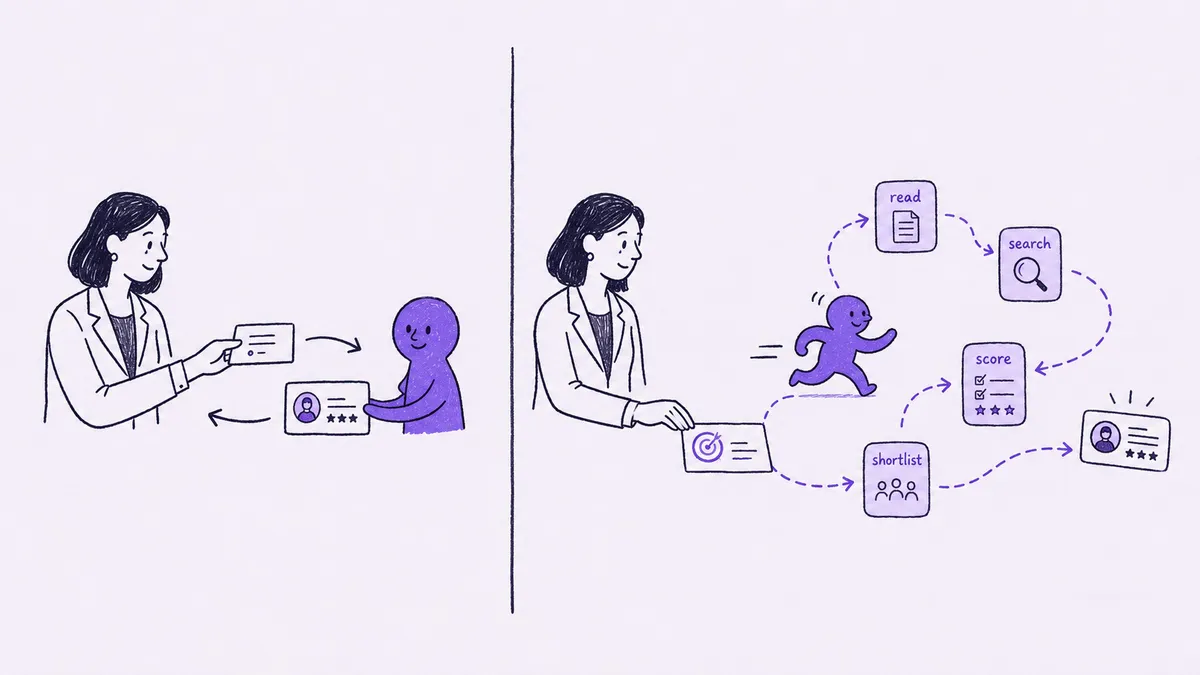
1. Who plans the steps? An assistant performs one requested action. You say "summarise this conversation", it summarises, done. An agent receives a goal ("find three suitable candidates for this job") and works out the intermediate steps itself — read the job, derive relevant criteria, search the database, score candidates, return the top results. The difference sits in orchestration: who decides which step follows which?
2. Which tools can the system use? An assistant has one interface — usually the chat itself, plus possibly file uploads. An agent has a structured set of tools, each with its own input and output: search-CRM, parse-CV, write-email, schedule-meeting, query-database. The agent picks which tool fits which step, and the tool returns structured data that feeds the next step. A chatbot without tools is not an agent, even if marketing suggests otherwise.
3. What does the system remember between steps? An assistant is mostly stateless — every conversation starts fresh, or at most with short conversation context. An agent maintains working memory about its task: which steps have I taken, what did I find, where did I get stuck, what is my plan for the next step. On top of that, it usually carries operational context (which fields exist in your CRM, which house style you use) that is loaded outside the individual task.
4. What does the system do on the outside? An assistant talks — it generates text, summarises, answers questions. The user picks up the result and does something with it. An agent changes the outside world: it updates a record, sends an email, schedules a meeting, creates a task. Or: it proposes such an action and executes it once a human approves. A system that only produces text is by definition not an agent.
| Dimension | Assistant | Agent |
|---|---|---|
| Step planning | Human drives every action | System plans autonomously |
| Tools | One (chat) or none | 5–20 specialised tools |
| Memory | Stateless or conversation-only | Working memory + operational context |
| Effect on systems | Generates text | Performs actions (or proposes) |
As soon as a vendor misses one of these four, "AI agent" is a marketing term for a different type of system. That's not a judgement — a well-built assistant is enormously valuable. It does matter for what you can expect from it, and which compliance layer goes around it.
The full spectrum: five categories that blur together
In practice, more than one step sits between "chatbot" and "agent". A workable 5-category model, built around the four dimensions above:
Chatbot. One question in, one answer out. No tools, no memory between sessions, no external actions. ChatGPT without plugins, or a rule-based bot from 2018. Suitable for Q&A, unsuitable for work processes that need to fetch or mutate data.
Assistant. Has tools and some memory, but doesn't plan on its own. You explicitly ask "summarise this conversation" or "write this email in my style", and it performs that one action. ChatGPT with file uploads and custom instructions. The human decides what the next step is.
Copilot. Suggests actions while you work, doesn't perform them itself. GitHub Copilot proposing code while you type. Microsoft 365 Copilot completing a slide while you build it. The centre of gravity stays with the human — the copilot only makes each step faster.
Agent. Receives a goal, plans the steps itself, uses tools, checks results, hands the final result to a human. "Find the three most suitable candidates for this role in our database" gets translated autonomously into searching, filtering, scoring, ranking, motivating. The human decides what happens with the final result.
Autonomous agent. Same plan-and-execute capability, but without prior end-control. The agent runs full flows — contacting candidates, scheduling meetings, initiating next steps — and the human becomes after-the-fact supervisor, not decision-maker. In recruitment, this level is legally fragile (see the EU AI Act mapping further down).
What is uncomfortable about this taxonomy: the same reasoning engine — Claude, GPT-5, Gemini — can sit in every category. The difference is not which model runs underneath, but what is built around it. Andrew Ng calls this "agentic workflows": the same model in different harnesses. A vendor saying "we have our own AI model" usually means "we have a wrapper around a third-party large model". That's not a problem; it is the reality that prevents you from reading off the model name what a system can do.
Recruitment examples per category
Abstract definitions only help when you put them next to concrete recruitment tasks. One example per category that you actually run into:
Chatbot — "questions about your HR handbook". An internal bot letting candidates or employees ask questions about leave policy, onboarding steps, or procedures. Pure text-in-text-out, no link to your ATS, no action. Useful for self-service, not recruitment work in any operational sense.
Assistant — "summarise this screening call". An AI that receives an interview recording, generates a summary, and possibly drafts an email to the hiring manager. The recruiter decides which summary lands in the candidate profile, which email gets sent, which candidate moves on. The assistant changes nothing autonomously.
Copilot — "write-with-me inside my ATS". A suggestion layer in your CRM that thinks along while you fill in fields, proposes a tag based on a CV, or recommends a next step based on where the candidate is in the funnel. The recruiter keeps typing; the copilot makes every field a second faster.
Agent — "match this job against our database". A system that autonomously reads the job, derives criteria, searches candidates, ranks across multiple dimensions, and returns a top 5 with motivation. The recruiter assesses the top 5, picks, takes action. This is where the real time savings sit for recruitment intelligence work.
Autonomous agent — "go through this longlist and reject who doesn't fit". A system that autonomously assesses candidates, sends rejection emails, and only forwards remaining candidates to the recruiter. Technically possible, legally classified as high-risk under the EU AI Act (see below), and under GDPR Article 22 the candidate has a right to human intervention in automated decisions. In practice, this level does not belong in a recruitment workflow without heavy legal infrastructure around it.
How to recognise in ten minutes what a vendor really sells
A vendor demo always shows the best result. You learn little from it about the architecture underneath. Three tests that do work, and that you can run in a first call:
The tool test. Ask: "give me a list of the discrete tools your agent can call". A serious agent vendor names 10–20 tools without hesitation, each with clear input/output: search-candidates, parse-CV, read-job, write-email, schedule-meeting, update-record. A vendor answering with "our AI can do anything" or "we have one central tool that calls everything" is most likely selling a chatbot or assistant with agent marketing.
The orchestration test. Ask: "which actions does the agent perform without confirmation, which require explicit approval, and which are forbidden entirely?" A serious vendor has a matrix ready. Reading and searching: free. Drafting a concept: free. Sending an email: confirmation. Mutating status: confirmation. Auto-reject: forbidden. A vendor that draws no distinction and lets everything run "automatically" has not built the orchestration layer properly.
The audit test. Ask: "send me a sample audit log of an agent action from last week". A serious vendor shows per action: which goal, which tool, which input, which output, which decision, which user, which timestamp, which correlation ID. A vendor unable to deliver this within a week cannot demonstrate EU AI Act Article 12 compliance either — and won't be able to by 2 August 2026.
Three questions, ten minutes, and you know which of the five categories the vendor sits in — independent of what the marketing claims.
EU AI Act mapping: which categories are still safe?
The EU AI Act does not address the five categories explicitly — the Act thinks in risk classifications, not in technical archetypes. But the practical mapping is straightforward, because Annex III section 4 classifies recruitment AI generically as high-risk as soon as the system screens candidates, ranks them, or supports decisions about employment relationships.
| Category | Recruitment use | EU AI Act status |
|---|---|---|
| Chatbot | HR FAQ, no decisions | Out of scope (unless it supports decisions) |
| Assistant | Summaries, draft emails | Limited risk — transparency obligations |
| Copilot | Suggestions during recruiter work | Limited risk — human stays decider |
| Agent | Matching, ranking, shortlisting | High risk — Annex III section 4(a) |
| Autonomous agent | Auto-reject, autonomous funnel decisions | High risk + GDPR Article 22 conflict |
In practice: from agent level (category 4) onwards you sit in high-risk territory and Articles 9 to 15 of the Act must be in order — risk management, data governance, technical documentation, logging, human oversight, accuracy and robustness. What that means concretely per article is in the EU AI Act deep dive for agentic recruitment, including the 8-point compliance checklist you can tick off per vendor.
The broader lesson: choosing between assistant and agent is not just a product decision. It is a compliance decision. An assistant carries far lighter obligations around audit, explainability, and risk management than an agent. A vendor that says "agent" without technically supporting those obligations shifts compliance risk over to you as deployer.
When to choose agent over assistant — and when not
Not every recruitment task calls for agent level. A workable decision heuristic:
Choose assistant (category 2) when:
- The task sits on the reactive side — summarising, drafting, answering — and ends with human review.
- The data input is structured per action ("here is this conversation, summarise") rather than an open instruction ("do something useful with this candidate pool").
- The audit load of a high-risk system isn't justifiable for the time you'd save.
- The task is sensitive in ways only human attention can catch — think: sensitive feedback to candidates, nuance in motivation letters.
Choose agent (category 4) when:
- The task has multiple steps a recruiter currently performs manually one after another — for example matching: read job, derive criteria, search database, score, rank, write motivation.
- The input data is structured enough that the agent can keep working without human intermediate steps.
- Your infrastructure is in order: audit logs, role-based access, candidate-rights flow, escalation path on errors.
- The compliance overhead (Articles 9–15) outweighs the time saved across all recruiters in your organisation.
Don't pick autonomous agent (category 5) in a European context. Not in 2026, not in 2027. The combination of EU AI Act Article 14 (effective human oversight) and GDPR Article 22 (right to human intervention) makes fully autonomous recruitment decisions legally highly fragile. Vendors offering this anyway shift the legal risk over to you. A separate piece is dedicated to the autonomous mode in recruitment with practical preconditions; short version: it does not belong in a production recruitment flow without heavy legal infrastructure.
What this means for your recruitment stack
The practical conclusion for a recruitment buyer in 2026: ask every vendor explicitly which of the five categories their product falls into, and pair that category with a responsibility matrix. For category 2 (assistant) you can roll out almost immediately — the compliance overhead is low, the time saved per task is directly measurable. For category 4 (agent) you need an implementation track where audit, oversight, and candidate rights are handled before go-live. For category 5 (autonomous), the answer in a European context right now is "don't".
At Simply the product sits explicitly at level 2 and 3 — an assistant for meeting summaries and CV formatting, and an agent for matching where every decision is returned to a recruiter with motivation. We don't build level 5 (autonomous reject decisions), not because it's technically out of reach but because it's legally irresponsible to ship to customers in a European context. That is a choice, not a shortcoming — and it belongs to the kind of question you should be asking every recruitment AI vendor before you sign.
For deeper reading: the agentic AI in recruitment guide covers the full autonomy spectrum across 5 levels and the architecture layers underneath. The EU AI Act deep dive gives the exact article numbers and the 8-point vendor checklist. And if you want to see what one concrete agent implementation looks like in production, Simply Ask and the 4-step matching system shows the tools, orchestration, and human checkpoints of a production agent in detail.