AI software for staffing agencies: a 2026 guide

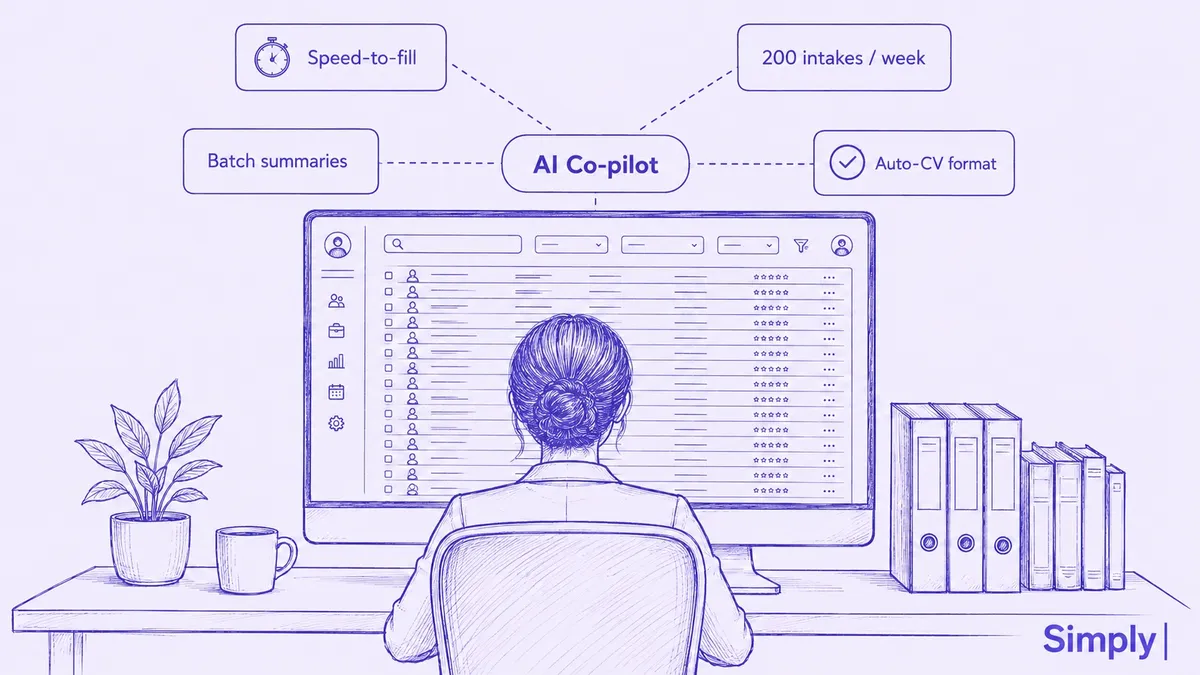
This guide goes deeper than the staffing section in our broader guide per agency type. That one has the overview. This one has the build-out, layer by layer.
Why staffing has its own math
Staffing isn't a small corner of the market. It is the market. In the second quarter of 2025, the flexible-work segment made up roughly 37.9% of all workers in the Netherlands, and temporary and seconded workers together accounted for around 3.5% of all employed people (CBS labour market dashboard). Industry body ABU, with more than 500 members, represents around 65% of the market (ABU market figures). It's large, it's competitive, and in 2025 it ran on a declining hours economy. That last point suddenly makes the cost side a lot more sensitive.
Here's the point. A staffing agency doesn't earn tens of thousands of euros in fees per placement the way an executive search firm does. It earns a few euros of margin per hour worked, times a great many hours. The profit sits in volume and in speed. A vacancy that comes in on Monday and is still open on Wednesday is a vacancy heading to the competitor down the road. Speed-to-fill isn't one of the KPIs. It is the KPI.
And that changes everything about how you look at AI. For an agency type that earns on depth, a tool may well spend five extra minutes on a richer candidate profile. For staffing the math runs exactly the other way. Every minute of admin a recruiter spends per candidate, you multiply by hundreds of candidates a week. Three extra minutes per intake write-up feels like nothing. Across 200 conversations that's ten hours a week. Per recruiter.
So the question for a staffing agency isn't "which AI is the smartest". The question is: which AI removes the most repeated minutes, across the largest numbers, without you paying for depth you don't use?
The stack, layer by layer
I split the AI stack for staffing into four layers that deliver a return, and one layer to be careful with. Per layer: what it does, and why it works at volume.
Layer 1: conversation AI for intakes, no write-up afterwards
The biggest hidden time sink in staffing isn't the conversation itself. It's what comes after. A recruiter runs a twenty-minute intake, hangs up, and then spends another fifteen minutes writing notes into the system. Those fifteen minutes are pure overhead. The candidate has already been spoken to, no new information is added, you're just retyping what you already know.
A notetaker or conversation AI records the call (online via Meet or Teams, in person via a mobile app, by phone via VOIP) and delivers a structured summary straight away. No more write-up. After the call the recruiter reads through a finished summary instead of typing from scratch.
For staffing this is the first layer you switch on, because it's the purest form of repeated time saving. Every conversation, every day, the same minutes saved. Watch one thing though: pick a tool that produces a fitting summary per conversation type. A candidate intake calls for different fields than an evaluation interview. Generic meeting notes ("here are the action items") help a recruiter less than a summary built for a staffing intake.
Layer 2: CV formatting into the end client's house style
This is the layer people underestimate. A staffing agency forwards CVs to the end client, often in the agency's house style, sometimes in the client's. That reformatting is done by hand right now. Logo on it, tidy up the layout, fix the typos, sections in the right order. Five to ten minutes per CV if you do it properly.
Five minutes per CV sounds harmless. But a staffing agency processing hundreds of CVs a week burns dozens of hours a week on formatting work that earns no extra euro. The end client doesn't pay for pretty margins in a Word document. Auto-formatting that turns a raw CV into the fixed house style, including language correction, is exactly the kind of work AI does cheaply and consistently, and people do expensively and with variation.
Do the math for yourself. It's almost always the layer with the fastest, hardest payback in staffing.
Layer 3: data entry into CRM and ATS
Recruiters hate data entry. Rightly so. It's retyping information that already exists somewhere into fields in a system. Desired salary, current salary, availability, location, driving licence, available hours. All mentioned in the conversation, all entered by hand.
Smart data-entry automation recognises those data points in the conversation or the CV and fills the right fields in your system. The difference with simply "pasting text" sits in the formatting. A good system understands a field is a dropdown, or an enum, and picks the right value instead of dumping free text. A validation layer (green when it's certain, amber when the recruiter should check) keeps quality up without a human reviewing every field.
For staffing this counts double, because your CRM or ATS is the engine under the whole operation. The faster a candidate is complete and correct in the system, the faster they're matchable for the next vacancy that comes in.
Layer 4: VOIP and telephony for fast screening
Staffing runs largely over the phone. The first screening is often a five-minute call: are you available, what are you looking for, is this profile still right? Those phone calls normally fall outside every notetaker, because most tools only record video meetings.
Native VOIP support changes that. A tool that records and summarises outbound and inbound phone calls (including Dutch 06 mobile numbers) pulls that fast phone screening into the stack. No more separate channel that stays undocumented. For a staffing agency making dozens of calls a day that's a layer literally nobody else covers, because most international tools skip telephony or offer it through expensive add-ons.
The layer to be careful with: autonomous agents
Here comes the warning. Right now the market is selling hard on "agentic recruiting": AI that assesses, ranks and rejects candidates by itself. At volume that sounds tempting. Hundreds of applicants, automatically sifted, done.
Don't do this without a human in the loop on the rejection. Under GDPR Article 22 every candidate has the right not to be subject to a decision based solely on automated processing that produces legal effects or similarly significant effects. An automated rejection falls squarely under that. At hundreds of rejections a week that's no longer a theoretical risk. It's a liability that stacks up with every decision.
And it gets stricter. Recruitment AI is classified as high-risk under the EU AI Act from 2 August 2026, with hard requirements around human oversight, logging and explainability. We wrote two separate pieces about this you should read before you sign: the practical side of GDPR and the AI Act for recruitment tools, and the deeper analysis of agentic recruitment under the EU AI Act.
This doesn't mean agents are worthless for staffing. An agent that pre-sorts, suggests, or assembles a longlist that a human then reviews is fine. The line is at the rejection. There a human must decide, and you must be able to demonstrate a human decided. At staffing scale that flow has to be watertight, not "we usually take a look".
What doesn't fit staffing
Just as important as what you do buy: what you leave on the table.
The biggest pitfall is buying tools designed for deep per-candidate research. Market mapping, extensive candidate dossiers, leadership profiles, sentiment analysis across multiple conversations. Those are brilliant features. For an executive search firm doing one placement a month at a fee of tens of thousands of euros. For a staffing agency placing a candidate on a margin of a few euros an hour, it's overhead no client pays for.
The same goes for relationship tracking with deep memory over years. That fits secondment, where the relationship with a professional runs for years and the value sits in repetition. In staffing the relationship is shorter and more transactional by definition. Investing in a deep insights layer for a candidate you may not speak to again in three months is capital in the wrong layer.
The rule is simple. In staffing you match the tool to the volume economics, not to what looks most impressive in the demo. Speed and throughput over depth. Every euro of AI budget belongs to the layers that remove repeated minutes across large numbers.
The ATS stays the engine, AI sits on top
A misconception I hear often: that a staffing agency should replace its ATS with "something with AI". That's the wrong framing.
Most staffing agencies run on a system of record that has driven the operation for years. Mysolution, Bullhorn, Carerix, OTYS. That system tracks your candidates, placements, contracts and invoicing. That's not a problem you solve, that's your foundation. An AI co-pilot doesn't replace it. It sits on top, fills it faster and more accurately, and removes the admin minutes.
So the question with an AI tool isn't "does this replace my ATS", but "does this integrate with my ATS". Does your Mysolution or Bullhorn appear in the vendor's official integration list? Or does it have to go via a workaround with Zapier? The difference is a week of implementation versus a quarter of frustration. Ask it explicitly, and ask for a reference from an agency running on the same ATS.

Simply
Simply sits in the recruitment intelligence category, alongside tools like Metaview, Carv and In2Dialog. We're not an ATS and don't want to be one. We're the co-pilot that sits on top of your existing ATS and covers the four return layers for staffing in a single layer.
Concretely for a staffing agency:
- Conversation AI across all channels. Online via Meet and Teams, in person via the mobile app, and by phone via native VOIP including Dutch 06 mobile numbers (Pro tier and up). Summaries per conversation type, not generic. Read more about the AI summaries.
- CV formatting into house style across hundreds of CVs, including language correction. The layer with the fastest payback at volume. See CV formatting.
- Smart data entry into CRM and ATS with recognition of dropdowns and enums, plus a validation system (green/amber) so you don't review every field by hand. See CRM data entry.
- Integration with your system of record. Mysolution, Byner, Tigris, Carerix, Recruitee, AFAS, OTYS and HubSpot, plus a free Salesforce managed app. We don't replace your ATS, we feed it.
- Conservative on autonomous rejection. Our matching and agentic features (Pro tier and up) are built with a human in the loop and EU AI Act conformity in the design. ISO 27001 certified and GDPR compliant, and your data isn't used to train AI.
For staffing agencies, secondment firms and search & selection that category fits well. For a one-person broker or pure executive search it's probably overkill, and we'll say so honestly in the first conversation. More on your specific economics is on the per-audience page for staffing agencies.
Where to start in week 1
Not with a tool list. With your own numbers.
Take a week and count three things. How many minutes does a recruiter spend on average on intake write-up after a conversation? How many CVs go to end clients per week, and how many minutes does the reformatting take? How much time disappears into manual data entry into the CRM? Those three numbers, multiplied by your number of recruiters, are your business case. Not an assumption, measured.
Only then the tool. Build a shortlist of vendors that explicitly serve staffing and integrate with your ATS. Request the compliance documentation before the demo, not after. And don't sign an annual contract without a pilot. Three to six weeks on one team, with the measured numbers from week 1 as a baseline. Not "does it feel good", but "does it save the ten hours a week per recruiter we calculated up front".
In staffing, with that thin margin and those large numbers, the right AI pays for itself in weeks. The wrong AI is overhead with a nice dashboard. The difference isn't in the cleverness of the tool. It's in whether it fits how you earn your money.