AI tools that work with your ATS: the guide (2026)

- The wrong question, and the right one
- Why your ATS stays in the lead
- The three integration levels
- The most-used ATSes in the Netherlands
- Which AI tool supports which ATS
- Simply
- Carv
- In2Dialog
- Metaview
- Fireflies
- What this means for your agency
- The practical benefits of a good connection
- Step plan: from ATS to AI layer
- In closing
Integration details verified via official vendor pages, May 2026. Vendors revise their connectors regularly. Where a connection is not listed on public pages, it's phrased as such, not as "cannot".
The wrong question, and the right one
Most buyer's guides for recruitment AI start with the tool. Which is best, which has the most features, which wins the comparison. For a recruiter who has worked in Bullhorn, Carerix, or a Salesforce setup for years, that's rarely the relevant question. You're not replacing your ATS because a new notetaker hit the market. Your ATS is where your vacancies, candidates, clients, and placements live. That stays.
The question that does matter: which AI tool works with the system I already have, and how deep does that connection go? Because there's a world of difference. One tool exports a text file you have to paste in yourself. Another writes fields straight into the right place in your ATS, reads your vacancies back, and matches against them. Between those two extremes sits most of the difference you notice in practice.
This guide is written for the Dutch recruitment landscape. We explain why your ATS stays in the lead, what the three integration levels mean, and which AI tool supports which system. No "we're the best" story: factual, sourced, and with the partner ATSes described neutrally, because they're integration partners, not competitors.
Why your ATS stays in the lead
There's a stubborn misconception that AI is going to replace your ATS. It won't, and it's not a desirable scenario either. An ATS does something fundamentally different from an AI co-pilot. The ATS is your system of record: the place that holds the truth about who your candidates are, which vacancies are open, which clients you work with, and which placements you've made. It's the legal and administrative foundation, often with years of history in it.
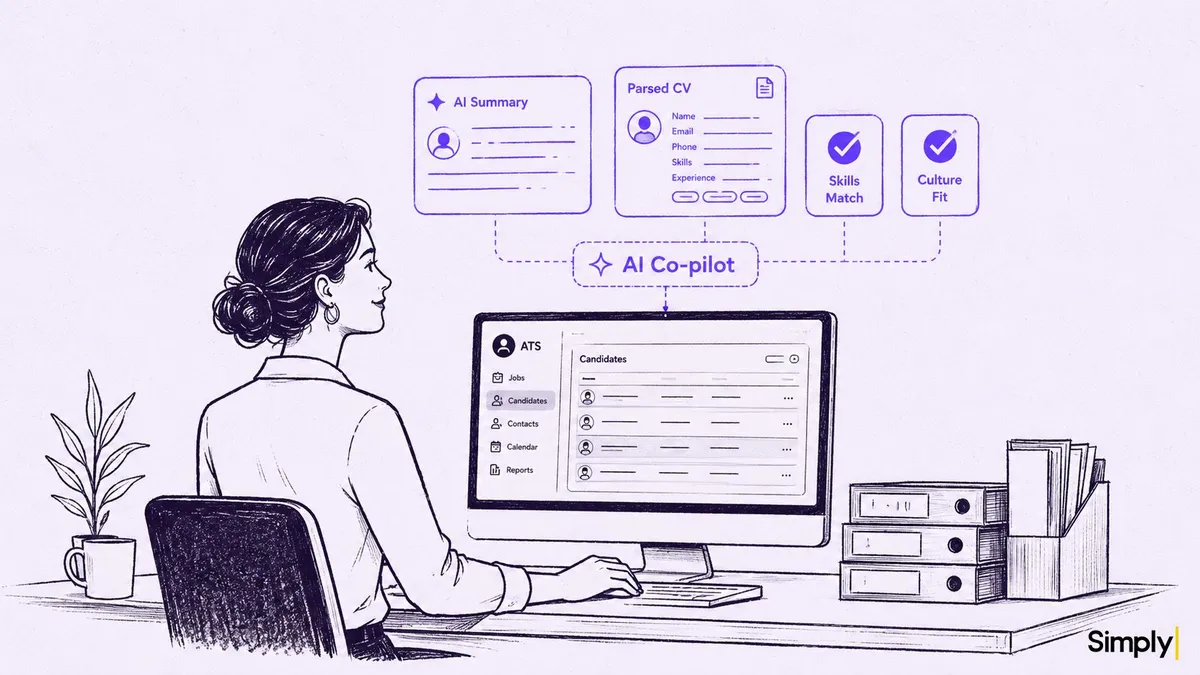
An AI tool is an intelligence layer that runs on top of that. It records conversations, summarises them, pulls data points from an intake, formats a CV to house style, or matches a candidate against a vacancy. Those are capabilities most ATS vendors don't build as a core competency, simply because their product is about something else: record-keeping, workflow, compliance, invoicing. That division of roles isn't a shortcoming, but a design choice that works in your favour. You don't buy a replacement, but an addition. The connection between the two decides whether that works or not.
Simply is, for that reason, explicitly not an ATS. It's recruitment intelligence that runs alongside and on top of your existing system. What a good connection means here, and why it isn't a given, is exactly what the rest of this article is about: how do you make that connection, and at what level.
The three integration levels
Not every "integration" is equal. Vendors use the same word for very different things, and that's exactly where the trap sits. We distinguish three levels. Know which level a tool offers before you sign, because the difference determines how much manual work remains after purchase.
Level 1: export and paste
The base level. The AI tool produces output, a summary, a parsed CV, a set of data points, and you copy it manually into your ATS. Sometimes via a clean export button, sometimes via copy-paste from a transcript. It works, and for a solo recruiter or a small team it's sometimes enough. But the time saved by the AI partly leaks away in the retyping. At volume that adds up fast.
Level 2: field-to-field automatic write-back
This is where it gets interesting. The tool writes data points straight to the right fields in your ATS. Desired salary goes to the salary field, availability to the availability field, a parsed CV lands on the candidate card. No more retyping. The win isn't only in time, but in data quality: fewer typos, consistent input, no fields someone forgets to fill in because it's Friday afternoon.
The tricky part at this level is field recognition. An ATS has dropdowns, enums, date fields, and required formats. A tool that can only write back plain text doesn't help you here. Simply handles this with smart field mapping: it automatically recognises that a field is a dropdown, a date, or a free-text field, and formats the data accordingly. On top of that a green-and-orange validation system, so you can see at a glance which data is certain and which deserves a human check. More on that on the page about smart CRM data entry.
Level 3: bidirectional, including matching
The deepest level. The connection works both ways. The AI tool doesn't only write back, it also reads. It pulls your open vacancies from the ATS and can match a candidate against them. It knows which client belongs to which assignment. Updates run real-time in both directions. This is the level at which an AI layer truly becomes part of your workflow instead of a separate tool beside it.
Simply offers this via the native managed Salesforce app on the AppExchange: real-time bidirectional, with support for standard and custom objects and picklists. For the direct connectors with Bullhorn, Mysolution, Byner, and Tigris the connection runs at comparable depth. How Simply sets up the integration in practice is described in connecting Simply to your ATS.
Tip for the vendor conversation. Don't ask "do you have an integration with my ATS?" That's too coarse, because the answer is almost always yes. Ask specifically: which of these three levels is that connection at, does it write to specific fields or only plain text, and does it read vacancy data back for matching? And ask whether the connector is native or runs through a middle layer like Zapier. The difference between native and middleware is often the difference between one week of implementation and a quarter.
The most-used ATSes in the Netherlands
Before we get to the AI tools, first the playing field. These are the systems you encounter most in the Dutch recruitment landscape. The descriptions are neutral and factual, based on the Recruitment Tech benchmark 2026. Important: for an AI co-pilot like Simply, these are integration partners, not competitors.
| ATS | Type | Strong at |
|---|---|---|
| Bullhorn | US ATS/CRM | Larger and international agencies |
| Mysolution | NL staffing/payroll platform (acquired OTYS) | Staffing and payroll, end-to-end |
| OTYS | NL agency ATS | Strong multiposting |
| Carerix | NL ATS/CRM | Relationship-driven work, top-rated in NL |
| Byner | NL, Salesforce-based | Staffing and secondment |
| Tigris | NL, Salesforce-native | Agencies on the Salesforce platform |
| Salesforce | Global CRM-as-ATS | Enterprise and consultancy |
| Recruitee | NL origin (now Tellent) | Corporate and in-house |
| Greenhouse | US enterprise ATS | Tech and scale-ups |
| AFAS | NL ERP/HR | Recruitment as a secondary module |
What stands out: the Dutch landscape is a mix of strong regional players (Mysolution, OTYS, Carerix, Byner, Tigris) and international systems (Bullhorn, Salesforce, Greenhouse). That split is exactly why the AI tool choice matters. A tool that connects brilliantly with Greenhouse and Ashby won't help you if your agency runs on Carerix or Mysolution, and the other way round just as much.
Which AI tool supports which ATS
This is where it comes together. The matrix below sets five frequently-named recruitment AI tools against the ATSes they support. A check means the connection is listed on public pages; a dash means it isn't. The latter is emphatically not a "cannot", but a "not documented at the time of writing".
| ATS | Simply | Carv | In2Dialog | Metaview | Fireflies |
|---|---|---|---|---|---|
| Salesforce | ✓ (native app) | — | ✓ | — | — |
| Bullhorn | ✓ | ✓ (embedded) | ✓ | ✓ | via middleware |
| Mysolution | ✓ | — | — | — | — |
| Byner | ✓ | — | — | — | — |
| Tigris | ✓ | ✓ (API) | — | — | — |
| Carerix | ✓ | ✓ (embedded) | ✓ | — | — |
| OTYS | ✓ | ✓ (embedded) | ✓ | — | — |
| Recruitee | ✓ | ✓ (API) | — | ✓ | — |
| AFAS | ✓ (on request) | — | — | — | — |
| Greenhouse | via REST API | ✓ (API) | — | ✓ | ✓ (native) |
| Lever | via REST API | ✓ (API) | — | ✓ | ✓ (native) |
| Ashby | via REST API | — | — | ✓ | ✓ (native) |
The matrix tells a story the individual marketing pages don't: the tools cluster around different parts of the market. Below, per tool, what the connection concretely involves.

Simply
Simply is a Dutch recruitment intelligence layer that works with your ATS rather than replacing it. The connection strategy is broad and covers both the NL and the international systems. The native managed Salesforce app is on the AppExchange and works real-time bidirectional, with standard and custom objects and picklists. Alongside that, direct connectors with Bullhorn, Mysolution, Byner, and Tigris. Carerix, Recruitee, AFAS, OTYS, and HubSpot are listed as integration targets on the integrations page; AFAS runs on request. For any other system there's a REST API.
What sets Simply apart isn't the number of logos, but what runs across the connection: smart field mapping that automatically recognises dropdowns, enums, and dates, plus a green-orange validation system that makes human oversight practical. The connection also reads vacancy data back for matching, so the third integration level. The Salesforce app is free; for the other connectors a one-time setup fee applies. Source: simplyrecruit.ai/en/features/integrations (2026-05-29).

Carv
Carv stands out with an embedded view: for Bullhorn, Carerix, OTYS, and Jobylon, Carv runs as a view inside the ATS, so the recruiter doesn't have to switch. For Lever, Greenhouse, Workable, Recruitee, Tigris, Avature, JobAdder, Loxo, and RecruitNow the connection runs via API. Carv has an official partnership with Carerix and supports VOIP via Aircall. On price, Carv sits around €60 per user per month (per Capterra). Strong at the Bullhorn/Carerix/OTYS combination, and broad across the international ATSes. Source: carv.com/integrations (2026-05-29).

In2Dialog
In2Dialog is, like Simply, a Dutch tool, with direct integrations for Salesforce, Bullhorn, Carerix, Ubeeo, and OTYS (the logos on the homepage). It fills your ATS during the interview with recognised data points. Telephony runs through a paid add-on. Mysolution, Byner, and Tigris are not mentioned on the public pages. Good coverage on the relationship-driven NL ATSes (Carerix, OTYS) and the international classics. Source: in2dialog.com (2026-05-29).

Metaview
Metaview lists 62+ recruiting tools on its integrations page, including Bullhorn, Recruitee, Personio, Greenhouse, Lever, Ashby, SmartRecruiters, Gem, Workday, and iCIMS. The method behind that number is not publicly specified. The NL-native ATSes (Mysolution, Byner, Tigris, OTYS, Carerix) are not named. That makes Metaview strong at international ATS stacks, with less coverage on the specifically Dutch systems, a factual observation, not a judgement. Source: metaview.ai/integrations (2026-05-29).

Fireflies
Fireflies is a general meeting notetaker with native ATS connectors for Ashby, Greenhouse, Lever, and BambooHR. Other systems run via viaSocket or Zapier; Bullhorn and Workable via middleware. There are no native connectors with NL-native ATSes, and no Dutch AI summaries (only raw transcription). That makes Fireflies mainly interesting for international, English-language stacks on the large US ATSes. Source: fireflies.ai/integrations/applicant-tracking-system (2026-05-29).
What this means for your agency
The matrix only becomes useful when you hold it against your own situation. Three scenarios.
You run on a Dutch ATS (Mysolution, OTYS, Carerix, Byner, Tigris). This is where the international tools let you down. Metaview and Fireflies largely don't name these systems. Your realistic options are Simply and Carv, with In2Dialog added for Carerix and OTYS. For the Mysolution/Byner/Tigris corner, Simply is currently the broadest, with direct connectors where the others list nothing. If you work at a staffing firm or secondment firm on one of these platforms, that's your starting point.
You run on Salesforce or Bullhorn. Here you have the most choice, because nearly everyone connects with these two. The distinction sits in the depth. For Salesforce, Simply offers a native managed app on the AppExchange, so no middle layer, with real-time bidirectional sync. For Bullhorn you have several serious options; ask each vendor specifically about the integration level from the previous section. A logo on a page says nothing about whether the connection is at level 1, 2, or 3.
You run on an international ATS (Greenhouse, Lever, Ashby). Then the whole market opens up. Metaview and Fireflies are strong here, with native connectors on exactly these systems. Simply and Carv connect too, via REST API and native API respectively. The choice then shifts from "who connects at all" to "who delivers the best intelligence layer and NL support", if the latter matters to you.
If you want to weigh this against your broader tool choice, not just the ATS connection but the whole fit with your agency economics, the guide to choosing recruitment AI per agency type is the logical next read.
The practical benefits of a good connection
Why all this fuss about integration levels? Because the difference between level 1 and level 3 is felt every day. A few concrete benefits of a deep connection.
Less duplicate work. A recruiter who retypes data points into the ATS after every conversation is doing work a good integration removes entirely. At hundreds of conversations a month, that's no marginal gain.
Better data quality. Manual entry means typos, forgotten fields, and inconsistent formats. A tool that writes back with field recognition and validation delivers cleaner data than a human on a Friday afternoon. And clean data is what your matching and reporting run on.
Matching that's right. A level-3 connection reads your actual open vacancies, not an exported snapshot. So the AI matches against what's open now, with the requirements as they stand in the ATS now.
Audit and traceability. Under the EU AI Act and GDPR you must be able to show what a decision was based on. A connection that makes every written value traceable, and with Simply links every sentence in a summary back to its source, makes that oversight practical instead of theoretical. More on that at transparency.
Step plan: from ATS to AI layer
A level-headed sequence for anyone now looking for an AI co-pilot to sit alongside the existing ATS.
Step 1. Establish which ATS you run and how central it is. If it's your system of record with years of data in it, the connection is the most important selection criterion, not the shiniest feature.
Step 2. Hold your ATS against the matrix above. Which AI tools name your system at all? Cut what doesn't connect right away. That often narrows the list considerably, especially with a NL-native ATS.
Step 3. From the remaining vendors, ask about the integration level. Level 1, 2, or 3? Native or via middleware? Does it write to specific fields? Does it read vacancies back? Send those questions before the demo, not during.
Step 4. Check the one-time cost and the lead time of the connection. A native app is usually live faster than a custom connector. Ask for a realistic implementation timeline, with references from clients on the same ATS.
Step 5. Pilot on one team before you sign. Measure whether the data actually lands cleanly in the ATS, and whether the time you save on retyping is real. Not "feels good", but measured.
In closing
Your ATS is the foundation, and it stays that way. The question with recruitment AI in 2026 isn't which system you replace, but which intelligence layer fits smoothly on top and how deep that connection goes. Start with your ATS, cut what doesn't connect, and with the rest ask specifically about the integration level.
Simply is built as the intelligence layer that works with your existing ATS, whether that's Salesforce, Bullhorn, Mysolution, Byner, Tigris, Carerix, or another system. If you want to see how the connection would run in your case, look at the integrations page, read how Simply works with your ATS, or the pillar on recruitment intelligence for the broader context.