Autonomous mode in recruitment: when it makes sense, when it doesn't, and what the threshold would be

- Why "autonomous" is back in vendor pitches
- What autonomous mode really means
- The legal wall in Europe
- The infrastructure you would need to build to consider this
- The economic case, honestly examined
- Three scenarios where autonomous claims break
- Why Simply explicitly does not deliver level 5
- The right ceiling in 2026
Why "autonomous" is back in vendor pitches
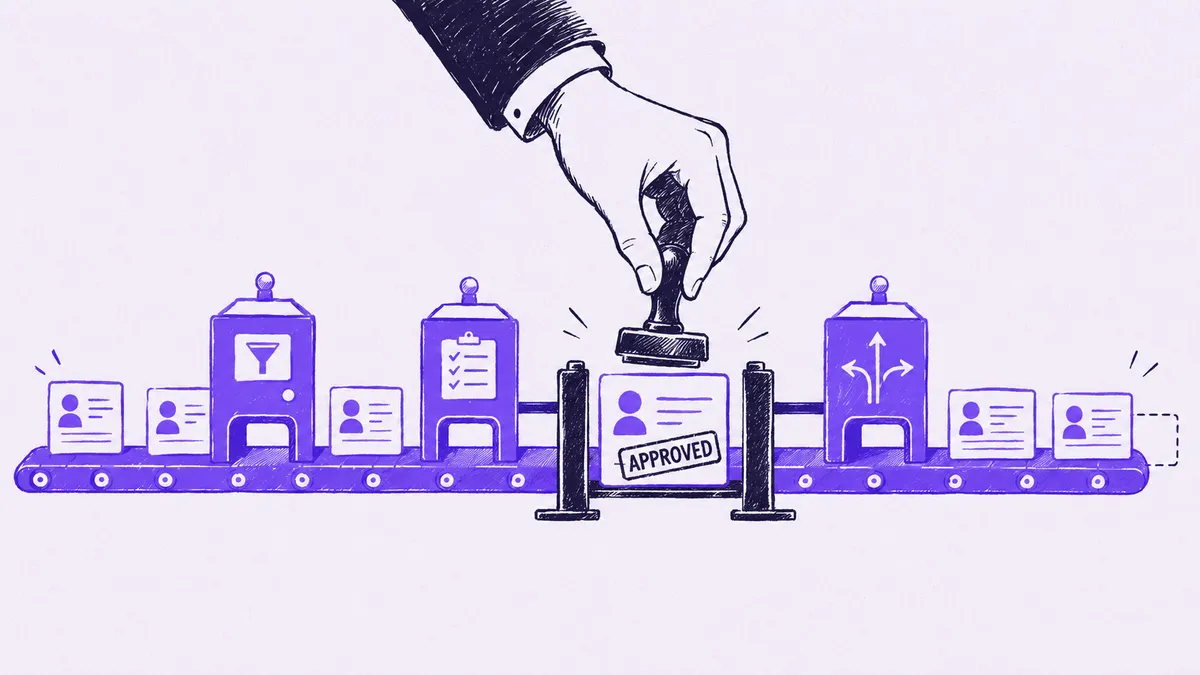
In vendor pitches from early 2026 you hear a new variant: "autonomous mode". The system runs through without human approval at each step. It screens a longlist, writes rejection emails, moves candidates through the funnel, schedules interviews, and only delivers a report afterwards. The pitch is tempting: instead of an agent that asks for confirmation on every decision, a system runs an entire recruitment flow end to end, and the recruiter is escalation-only.
The problem with that pitch isn't that it's technically impossible — it isn't. An agent that plans, uses tools, and keeps memory can in principle run without confirmation checkpoints. The problem is that the legal and operational consequences of that step are massively underestimated in the conversation that surrounds it. Whoever claims to deliver autonomous in 2026 is delivering either something that doesn't comply with EU law, or something that isn't technically "real" autonomous.
Three questions this article answers:
- What exactly is autonomous mode, and where is the threshold relative to an agent? Not what the marketing says — the operational definition.
- Which legal and infrastructural requirements would you need to put in place to run autonomous responsibly in a European context? And why almost nobody can do that in 2026.
- Which ceiling is sensible at this stage? And what would have to change to raise it?
What autonomous mode really means
In the 5-category model, autonomous sits as category 5 — one rung above "agent". The difference comes down to a single hinge: who decides on the external action?
With an agent (category 4), the architecture is: goal → planning → tool execution → end result → human decides on action. The agent proposes a top 5 candidates, drafts a rejection email, schedules an interview slot — but the recruiter clicks approve before it touches the outside world. With an autonomous agent (category 5), that checkpoint disappears. The system performs actions as soon as they are ready. The recruiter sees them after the fact, in a dashboard or a daily report.
That sounds like a small difference. It is fundamental. Agent mode shares end-responsibility: the system generates options, the human picks. Autonomous mode shifts end-responsibility: the system picks, the human can only correct after the fact. For recruitment decisions — which determine someone's access to work — that is a shift with legal, ethical, and operational consequences that stay out of frame in most vendor pitches.
What many vendors call "autonomous mode" is in practice something else: an agent in which a built-in confirmation rule has been switched off per action type. "Send email without confirm = on, create task without confirm = on, mutate status without confirm = on." That isn't autonomous — that's an agent on a longer leash. The real autonomous-mode level is: the system itself decides that an action is needed, without a human in the loop at all. In recruitment, concretely: the system decides on hire/reject without any human go-signal.
The legal wall in Europe
For the European context, two legal frameworks block the road, and they stack on top of each other.
GDPR Article 22 — right to human intervention. Article 22 of the GDPR gives every individual the right not to be subject to a decision based solely on automated processing that produces legal effects or similarly significantly affects them. A rejection on a job application falls explicitly under "significantly affects" — that is settled jurisprudence, not interpretation. An autonomous agent that rejects candidates without human intervention violates this right directly, no matter how much explainability is layered on top. The exceptions — consent, contractual necessity — are practically unusable for recruitment because they are either not freely given (power imbalance candidate vs employer) or the initial rejection has already happened before any contractual relationship exists.
EU AI Act Article 14 — effective human oversight. Article 14 of the EU AI Act requires for high-risk AI systems — which recruitment AI is, under Annex III section 4 — that a human can effectively oversee the system during use. "Effective" is the operative word here. A dashboard where the human can see after the fact what the agent did does not qualify as oversight in the sense of Article 14 — that is post-hoc review. Effective oversight means: the human can understand the output, be able to intervene before the effect becomes irreversible, and in extreme cases stop the system. An autonomous mode in which rejections have already been sent before the human sees them does not meet that requirement. From 2 August 2026 onwards, this requirement is also enforceable — see the EU AI Act deep dive for the broader context of what activates on that date.
The combination of GDPR Article 22 (right to human intervention) and AI Act Article 14 (mandatory effective oversight) makes it practically not legally defensible in Europe to roll out an autonomous recruitment mode that decides on candidates without a human go-signal. Not impossible to build, not impossible to sell — impossible to defend before a regulator or a court.
The infrastructure you would need to build to consider this
Hypothetically: suppose a future legal context did allow it. What infrastructure would have to be in place before autonomous mode is operationally responsible? Four pillars:
1. Per-decision audit that is immutable. For every autonomous decision, a record containing: the exact input frame (CV text, job criteria, scoring model version), the intermediate reasoning (which tool was called with which input, which result came back), the final decision with rationale, and a timestamp with correlation ID. Immutable means: append-only, hashed, not editable by the operator itself. What EU AI Act Article 12 demands as minimum is a floor for autonomous — you need far more detail to be able to reconstruct what happened when a complaint comes in.
2. Real-time bias monitoring with automatic pausing. Not just periodic bias audits, but continuous monitoring: if the rejection rate for a given demographic sub-population crosses a threshold, the system is automatically paused and an alert is sent to a responsible owner. This isn't tooling you bolt on later — it's a design starting point. In most vendor implementations this level of monitoring doesn't exist, and it is technically significantly more complex than a dashboard with historical statistics.
3. A formal candidate appeal route with SLA and independent review. An autonomous rejection without a fast, easy, and actually effective appeal path isn't oversight — it's a wall. That means: a procedure where a rejected candidate can request a review within a short window (for example five working days), and that review is handled by someone other than the system (or the team operating it). Operationally: this costs human capacity. The cost saving of autonomous gets largely eaten up by the staffing you need for the appeal route. Many vendors leave that cost out of the business case.
4. Documented human kill-switch per organisation and per cohort. A responsible owner inside the deployer organisation must be able to stop the system (or a specific flow within it) immediately without vendor assistance — and that stop must take effect within seconds, not hours. In production this means: a kill-switch that doesn't run through a ticketing system. It also means you need to be able to pause per cohort of vacancies, not just the entire system — otherwise it's unusable in operational terms.
Adding up these four requirements: it isn't impossible, but it's a different kind of product than what vendor pitches call "autonomous mode". It's a production system with a compliance layer that usually costs more than the time gain delivered by autonomous processing. Most vendors don't have this infrastructure, and they can't hide that from serious due diligence either.
The economic case, honestly examined
An argument that comes up repeatedly in vendor conversations: autonomous saves so much time that the legal risk is justified. That calculation deserves a sober check.
Where does the time gain of autonomous over agent mode actually sit? With an agent under human approval, a recruiter typically spends 5 to 30 seconds per proposed action — read it, approve, done. With autonomous, that handful of seconds drops away. If you have 200 actions per day, that's roughly 30 to 100 minutes per recruiter per day. Real, but not a 10x saving.
Against that sit operational costs that go up in autonomous mode, not down: bias monitoring with dedicated capacity, appeal routes with SLA staffing, audit-logging infrastructure that needs to retain more detail, legal advisory around every significant system change, and a higher reputational risk that translates into more expensive PR and relationship-management costs the moment one candidate files a complaint with the data protection authority. The net calculation tilts towards agent mode in many organisations, not autonomous.
On top of that: the most time-consuming parts of a recruiter's day are not "approve a generated rejection". The time sits in searching, having conversations, briefings with hiring managers, and candidate relationship management. A good agent mode takes most of that first slice off the table — the additional gain of autonomous on top is incremental, not transformative.
Three scenarios where autonomous claims break
Three concrete situations I see in vendor conversations, where the claim "autonomous mode works for our customers" needs to be unpacked.
Scenario 1 — "we are autonomous but not for rejections". The system accepts and escalates autonomously, but rejections require human approval. Operationally that sounds reasonable, but it isn't autonomous mode in any legal sense — and honest marketing would position it as agent mode with asymmetric confirmation. No problem, as long as it's sold that way.
Scenario 2 — "we are autonomous but the recruiter can revert within 24 hours". A rejection is sent; within 24 hours the recruiter can undo it and bring the candidate back. The problem: by the time the recruiter sees it, the candidate has already read the email, possibly already finalised an application elsewhere, and may already have filed a complaint with the regulator. "Reversibility" after the fact is not oversight in the Article 14 sense; it is damage control after the fact.
Scenario 3 — "we are autonomous for lightweight roles". The reasoning: for internships, holiday workers or seasonal jobs the stakes are lower, so autonomous is acceptable. Legally it makes no difference — Annex III section 4 doesn't distinguish based on role seniority. GDPR Article 22 doesn't distinguish between senior and junior. A rejection for a holiday job is just as much a rejection as one for a director role. The stakes argument is an operational argument, not a legal one.
Why Simply explicitly does not deliver level 5
At Simply the product line sits at level 2 and 3 (assistant for meeting summaries and CV formatting, agent for matching) and we don't build level 5. Not because it's technically out of reach — the architecture you'd need to run autonomously is largely already in our stack. We don't build it because it's legally irresponsible to ship to clients in a European context right now, and because the operational costs of doing it responsibly largely cancel out the time gain.
That's a design choice, not a shortcoming. The difference between a serious recruitment AI vendor and an opportunistic one is precisely this kind of choice: not building everything that's technically possible, but what's operationally defensible for the customer deploying it. When a vendor pitches you autonomous mode in 2026, ask which of the four infrastructure pillars (audit, bias monitoring, appeal route, kill-switch) they have actually delivered, and which they push down to "deployer responsibility". The answer to that question separates product responsibility from marketing.
The right ceiling in 2026
For a recruitment team building an AI stack in 2026, the practical ceiling is: agent mode with asymmetric confirmation. That means: reading, searching, summarising, generating drafts, and internal notes can be autonomous; all external actions (candidate emails, status mutations, hiring decisions) require human approval. Within that ceiling an agent can take over 70 to 80 percent of routine recruiter work, with an audit trail that is Article 12 compliant and a decision architecture defensible before a regulator.
What would have to change to raise that ceiling? Three developments at once: (1) jurisprudence or new legislation that explicitly broadens the GDPR Article 22 exceptions for recruitment, (2) a European standard for automatic bias monitoring that moves from "best practice" to "verified neutral", and (3) a legally recognised form of pre-vetted algorithmic decision-making — comparable to what is slowly taking shape in financial credit decisions. None of those three is close in 2026. The cautious estimate: 2028–2030, provided broader AI regulation develops in a productive direction.
Until then: agent with a human decision on the critical path. Not as a compromise, but as the right call. For readers who want to extend the line of thinking: the agentic AI in recruitment guide covers the full autonomy spectrum across 5 levels and the architecture layers underneath, and the agent vs assistant article gives the 4-dimension framework and the 10-minute vendor test to check which category a vendor really sits in.